
Emission sources (A_05)
The main causes of air quality deterioration in the port are related to dust and particulate emissions
The main sources of emissions in the port and their significance are detailed below:
| Type of activity | Order of relevance3 |
|---|---|
| Industrial activities in concessions (Calculated as the number of concessions where industrial activities involving emissions channelled into the atmosphere are carried out) | 1 |
| Emissions from vehicle engines | 2 |
| Emissions from ships and cruise ships at berth | 3 |
| Bulk solids handling by conventional means (Calculated as the number of licensed stevedoring companies moving bulk by grab/hopper-conventional/truck or grab/dock-stockpile/shovel/truck or truck/mobile-belt-conventional) | 4 |
| Bulk handling by means of special uncovered systems. (Calculated as the number of companies that have continuous uncovered or partially covered haulage systems) | 5 |
| Outdoor storage of bulk solids (Calculated as number of concessions storing bulk solids outdoors) | 6 |
| Emissions from unroofed lorry bodies | 7 |
| Works | 8 |
| Ship hull cleaning and painting (Calculated as the number of concessions performing hull cleaning and painting outdoors) | 9 |
| Other activities (please specify) |
3) Order of relevance Enter the order of relevance of each hotspot with numbers from 1 onwards, until all significant hotspots present in the port(s) are covered.
Complaints about air emissions (A_06)
Huelva Port Authority has a specific procedure for receiving and handling environmental complaints within its Integrated Quality and Environmental Management System. These complaints are referred to the relevant department for resolution. The resolution of the complaint is communicated to the person or organisation concerned via the Integrated Management System.
No formal complaints were received in this regard during 2025.
The Port Authority continues to collaborate in the monitoring of environmental aspects related to port operations and those of concessionary companies, carrying out specific monitoring for incidents of potential atmospheric emissions in the service area in order to establish appropriate preventive and corrective measures, where necessary.
Measures adopted by the Huelva Port Authority to control emissions (A_07)
The measures implemented are:
- Supply and installation of wheel washers at the Ingeniero Juan Gonzalo Quay.
- Guidelines on best practice.
- Direct supervision on the quay by Port Authority technicians.
- Sprinkler systems for bulk storage areas and access roads.
- Wind speed-linked warning and information systems.
- Air quality forecasting system.
- Fixed sprinkler system in the storage area of the Ingeniero Juan Gonzalo and Ciudad de Palos quays.
- Mobile irrigation system and intensive cleaning of road spills.
Air quality monitoring (A_08)
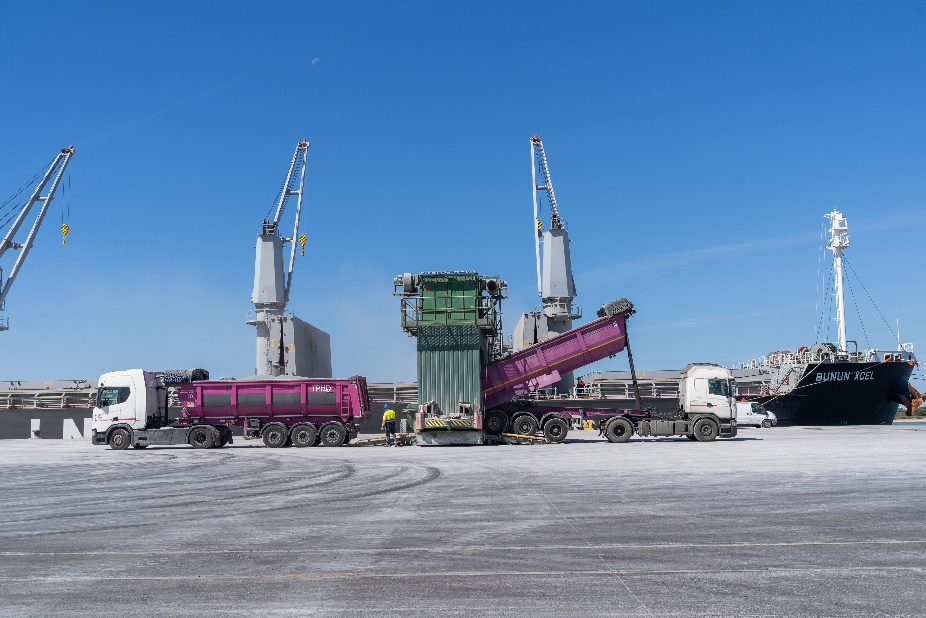
With regard to air quality control, operations are continuously monitored, particularly in areas where solid bulk materials are loaded and unloaded (as these are the most significant sources of air pollution), with specific measures put in place during operations, including misting with sprayers where necessary for operations involving high levels of dust.
In the rest of the service area, intensive monitoring is also carried out by the Sustainability and Energy Transition Department, with the aim of identifying needs and establishing the corresponding preventive and/or corrective measures, where appropriate.