
Landfill sources (A_10)
The measures implemented to improve and control the quality of the waters in the port of Huelva are:
| Origin of the discharge | Order of relevance4 |
|---|---|
| Rivers, streams, wadis or irrigation ditches | 1 |
| Industrial discharges from port concessions | 2 |
| Unregulated discharges from ships (bilges, etc.) | 3 |
| Refuelling and provisioning of vessel at quayside | 4 |
| Accidental spills during loading/unloading of bulk liquids | 5 |
| Bad practices in cleaning and maintenance of docks and equipment | 6 |
| Spills in loading/unloading of bulk solids | 7 |
| Dredging | 8 |
| Urban Treated Waste Water (WWTP's) | 9 |
| Cleaning and sandblasting of ship hulls | 10 |
| Works | 11 |
| Unchannelled or untreated rainfall or irrigation runoffs | NA |
| Untreated urban waste water | NA |
| Bunkering of vessels at anchor | NA |
| Other discharges (please specify) | NA |
4) The order of relevance is listed in ascending order from 1 onwards. NA, Not Applicable.
The main cause of deterioration in the quality of the port’s waters is discharges upstream into rivers and streams, including acid drainage from mines. An inventory and characterisation of the various sources of discharge and pollution of the port’s waters has been carried out.
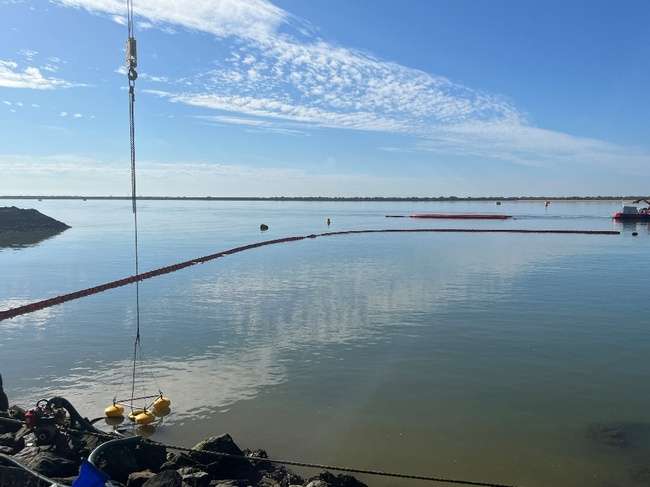
Measures adopted by the Huelva Port Authority for the control of discharges (A_11)
The measures implemented to improve and control the quality of the waters in the port of Huelva are:
- Connection of the South Quay to the sewerage system.
- Collection of water on the quays and fitting of paving on the Ing. J. Gonzalo and C. de Palos quays.
- Connection of the sewerage system to the main network in the area around the Columbus monument.
- Regular campaigns to assess water and sediment quality.
- Direct supervision on the quays by Port Authority technicians.
- Installation of designated areas for equipment cleaning and maintenance.
- Improvements to stormwater management (collection, channelling, catch basins, storm water tanks, etc.).
- Specific environmental requirements regarding wastewater and stormwater management in concession grant conditions.
- Environmental requirements regarding equipment maintenance and cleaning in service specifications and concession terms.
- Good practice agreements.
- Approval of Internal Maritime Plans (PIM) for responding to marine pollution emergencies.
- Improvements in the provision of dedicated resources for combating accidental marine pollution.
During audits for environmental best practice incentives, all binding environmental authorisations are reviewed. Furthermore, the Department of Sustainability and Energy Transition has been monitoring of all these requirements.
Notable actions carried out by Huelva Port Authority in 2025 include the “upgrading of drainage in the back street of the Huelva Port workshops”, the “new drainage system and lining of gutters on the new access road to the machinery park”, “works to improve the stormwater network around the Monument to Columbus” and “drainage of the coastal road from KP 2+300 to KP 2+580”
Water quality characterisation campaigns (A_12)
During 2025, no water quality monitoring campaigns were carried out in the Service Area other than those arising from EIA obligations.
However, eleven water quality characterisation campaigns5 were carried out in connection with dredging works. The parameters typically measured during these characterisation campaigns include: dissolved oxygen, pH, redox potential, conductivity, temperature, salinity, turbidity, suspended solids, total nitrogen, phosphates, oxidisable organic carbon and metals (mercury, cadmium, lead, copper, zinc, chromium, nickel and arsenic).
5) In relation to the EIA and Resolution of 16 December 2024 of the Directorate of Quality, Environmental Assessment and the Natural Environment
Sewerage and wastewater treatment network (A_13)
Within the Port of Huelva’s service area, the facilities designated for industrial use have their own sewerage network connected to the municipal network. As for the remaining areas used for port activities, there is also an extensive sewerage network that collects wastewater and conveys it to the Municipal Wastewater Treatment Plant for final treatment.
In detail, the proportions are as shown in the table below:
| Type of treatment | % of area6 |
|---|---|
| Percentage of the area of the land service area with sewerage network (irrespective of where it discharges and the treatment received) | 100.0 |
| Percentage of the area of the land service area with sewerage connected to the municipal sewerage system or to a WWTP | 99.9 |
| Percentage of land area discharging to septic tanks | 0.01 |
6) These percentages refer to the service area of the port with facilities and in which port operations are or may be carried out. The area of the service area corresponding to marshland and without facilities has been disregarded for this list.
Runoff water treatment (A_14)
With regard to stormwater, the extent of collection is indicated below:
| Type of network | % of area7 |
|---|---|
| Percentage of land area with runoff collection network. | 100% |
| Percentage of the surface area of the Service Area with runoff water collection and treatment. | 100% |
7) It should be noted that these percentages are percentages in relation to the service area in which activities are or may be carried out. The area of the service area, which corresponds to marshland and has no facilities, has been disregarded.
The stormwater tank at the Ingeniero Juan Gonzalo Quay is currently used to collect rainwater.
Schematic description of the technical means used for cleaning the sheet of water and weight of flotsam collected in the year (A_15)
On 6 September 2025, Huelva Port Authority (2025–2030) signed a new contract for the maintenance of navigational aids and the fight against marine pollution. This contract includes the cleaning of the water surface, is valid for a period of 3 years, and extendable for a further 2 years at the discretion of Huelva Port Authority.
The following table details the service for the removal of floating debris from the port’s water surface during 2025:
| No of vessels | 3 |
| Frequency of cleaning | In the presence of floating elements |
| Weight of waste collected in mt | 7.093 |
Activation of the Maritime Interior Plan (MIP) (A_16)
| Number of marine pollution incidents that did not require activation of the MIP* | 0 |
| Number of marine pollution emergencies that have required the activation of the MIP. Of any concession without activation of the Port's IMP ("Alert") | 3 |
| Number of marine pollution emergencies that have required the activation of the Port's MIP ("Alert") (**) | 4 |
| Number of marine pollution emergencies that have required the activation of the National Maritime Plan ("situation 1 or higher") | 0 |
(*): In accordance with the procedures established in the APH PIM, the activation of the PIM for any concession requires the activation of the APH PIM at least at the alert stage.
(**): Activation of the APH PIM in Emergency Phase, Response Level 1 or 2.
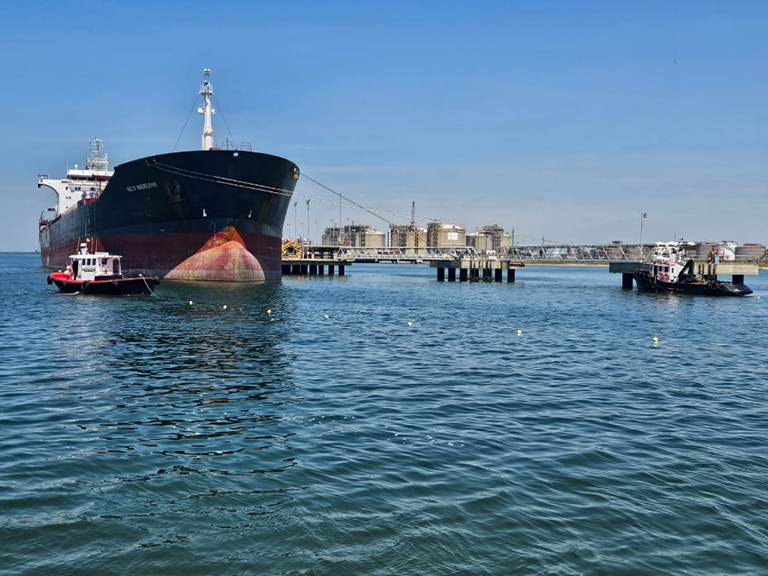
Volume of waste water discharges generated by the Port Authority, or discharged through sewers owned by the Port Authority, broken down by type (A_17)
The activities of Huelva Port Authority that generate wastewater discharges originate from:
- Offices, Levante Quay: UWW (Urban Wastewater)
- South Quay: UWW (Urban wastewater)
- Ingeniero Juan Gonzalo Quay: IWW (Industrial wastewater)
The destination of this wastewater:
| Municipal sewer | Offices and Muelle Levante (Rainwater drains) |
| Sanitation network | Muelle Sur (Offices): connection to sewerage system |
| Own treatment | In operation at Muelle Ingeniero Juan Gonzalo: storm water tank |
All the water discharged into the estuary is rainwater. There are various points of clean rainwater within the service area that, due to their condition, do not require treatment, nor do they have flow or volume measurement devices.