
Evolution of annual accident frequency rate (FR) (S_14)
IF = (total number of accidents with sick leave / number of hours worked) x 106
| 2023 | 2024 | 2025 | |
|---|---|---|---|
| No. of accidents with sick leave per million hours worked | 17.56 | 2.84 | 8.38 |
Evolution of the annual accident severity rate (SR) (S_15)
IG = (number of days lost due to accidents / number of hours worked) x 103
| 2023 | 2024 | 2025 | |
|---|---|---|---|
| No. of days lost per 1,000 hours worked | 0.09 | 0.04 | 0.27 |
Effort made in occupational risk prevention training (S_17)
| 2025 | |
|---|---|
| Total number of training hours | 1,925 |
| Total no. of employees (annual average workforce) | 217 |
| Average number of hours per worker | 8.87 |
Security and safety exercises and simulations (S_18)
The following safety and security drills and simulations were carried out in 2025.
Under Regulation (EU) No 725 – Security:
| Port Installation | Exercise Date | Topic | Type | Exercise Type (simulated, real, partial, complete) | Exercise Objective | Participants | Responsible |
|---|---|---|---|---|---|---|---|
| ESHU-0017 TERMINAL BULK SOLIDS | 2025/09/17 | Cyberattack | Exercise | Real | Train company staff to assist the IT Department in identifying and responding to this type of attack. | All APH staff | J. IT Dept. |
| ESHUV-007 LEVANTE SUR | 2025/09/17 | Cyberattack | Exercise | Real | Train company staff to assist the IT Department in identifying and responding to this type of attack. | All APH staff | J. IT Dept. |
| ESHUV-0029 MUELLE SUR | 2025/09/17 | Cyberattack | Exercise | Real | Train company staff to assist the IT Department in identifying and responding to this type of attack. | All APH staff | J. IT Dept. |
| ESHUV-0029 MUELLE SUR | 2025/05/21 | MARSEC – Explosive attack on the DECAL fishing vessel | Practice | Real | Train the Order and Safety Group and the Protection Organization's staff on the procedures established in the Port Protection Plan. | See attached report | OPP |
| ESHUV-0010 FERTIBERIA ABONO | 2025/05/29 | Threat of explosive placement | Practice | Simulated | Train the Order and Safety Group and the Protection Organization's staff on the procedures established in the Port Protection Plan. | OPP / CPCS Operators / OPIP LP /PP. | OPP |
| ESHUV-0029 MUELLE SUR | 2025/05/29 | Threat of explosive placement | Practice | Simulated | Train the Order and Safety Group and the Protection Organization's staff on the procedures established in the Port Protection Plan. | OPP / CPCS Operators / OPIP LP /PP. | OPP |
| ESHU-0017 TERMINAL BULK SOLIDS | 2025/05/29 | Threat of explosive placement | Practice | Simulated | Train the Order and Safety Group and the Protection Organization's staff on the procedures established in the Port Protection Plan. | OPP / CPCS Operators / OPIP LP /PP. | OPP |
In the context of the Port Security Plan:
| Exercise date | Topic | Type | Exercise type | Exercise objective | Participants | Responsible |
|---|---|---|---|---|---|---|
| 2025/09/17 | Cyberattack | Exercise | REAL | Train company staff to assist the IT Department in identifying and responding to this type of attack. | All APH staff | J. IT Dept. |
| 2025/05/21 | MARSEC – Explosive attack on the DECAL terminal from the fishing vessel | Practice | REAL | Train the Order and Safety Group and the Protection Organization's staff on the procedures established in the Port Protection Plan. | See attached report | OPP |
| 2025/12/29 | Threat of explosive placement | Practice | SIMULATED | Train the Order and Safety Group and the Protection Organization's staff on the procedures established in the Port Protection Plan. | OPP / CPCS Operators / OPIP I.P / PP | OPP |
Under the Port Self-Protection Plan:
| Exercises / practices | Exercise type | Objective | Location | Date | PAU activation | Participants |
|---|---|---|---|---|---|---|
| Cycle I Practice | Practice | Water supply in large fires | Muelle Juan Gonzalo | 2025/01/15; 2025/02/05; 2025/02/26; 2025/03/04; 2025/03/18 | No | Group Six Remolcador Cierzo |
| Cycle II Practice | Practice | Knowledge of the port environment | Muelle Sur | 2025/04/02; 2025/04/23; 2025/05/06; 2025/06/19; 2025/09/10 | No | Group Six Yilport Operators |
| Cycle III Practice | Practice | Industrial fire protocol | Muelle Sur Yilport Facilities | 2025/09/17; 2025/10/08; 2025/10/22; 2025/11/05; 2025/12/19 | No | Group Six Yilport Operators |
| Maritime Interior Plan | |
|---|---|
| 2025/03/17 | PIM activation drill at Petropesca Levante Norte |
| 2025/03/26 | PIM activation drill at FERTIBERIA |
| 2025/05/22 | PMN – PIM APH – PIM MOEVE – PECLA activation drill |
| 2025/06/12 | PIM DECAL activation drill |
| 2025/07/17 | PIM IMPALA activation drill |
| 2025/11/06 | PIM ENAGAS activation drill |
| 2025/11/27 | PIM ATLANTIC COPPER activation drill |
| 2025/12/10 | LEATRANSA PIM activation drill |
| 2025/12/17 | PIM DECAL activation drill |
| 2025/12/18 | PIM IMPALA activation drill |
With regard to the annual Port Protection Plan exercise, the following objectives were set:
- To improve inter-agency coordination of response and collaboration in the face of terrorist threats.
- To increase the capacity for reaction and coordination between agencies and institutions, with the aim of ensuring an optimal response to a terrorist threat against critical infrastructure.
- Activation and testing of the Huelva Port Protection Plan in the event of a terrorist threat.
- The following institutions, bodies and units participated in and contributed to the exercise: The Navy: operational support functions for the Civil Guard unit carrying out the boarding of the vessel occupied by the terrorist cell. Exchange of intelligence and information in support of the Civil Guard’s operation. Collaboration in the search for a possible explosive device submerged in the cliff face of the South Quay.
- Civil Guard:
- Civil Guard Special Intervention Unit (UEI): interception, boarding and securing of the fishing vessel.
- Civil Guard Headquarters:
- Criminal Intelligence Group (GIC): Leading the investigation.
- Maritime Service: Surface security and boarding of the vessel used by the terrorist cell.
- Canine Service: Search and detection of explosives.
- Explosive Ordnance Disposal Team (EDEX): Deactivation of the explosive device.
- Complex Operations Centre (COC): provision of the required resources, coordination of own units and with the operations centres of other agencies,
- Public Safety Unit (USECIC): Support in establishing the security perimeter.
- Coastal and Border Maritime Surveillance Coordination Centre (CECORVIGMAR): exchange of information with the Navy’s Maritime Action Operations and Surveillance Centre (COVAM).
- Huelva Port Authority: activation of the Port Protection Plan, implementation of the security measures set out therein, coordination with the forces involved and communications with all port facilities in accordance with established communication protocols.
In general terms, the exercise was as follows:
As part of a Civil Guard investigation into jihadist terrorism, the existence of a cell is confirmed which intends to carry out an attack in the Port of Huelva by placing an explosive device to be detonated from a fishing vessel sailing in the outer waters, using the vessel as a means of escape once the explosives have been detonated.
The GIC of the Huelva Command determined the need to establish an operation for the search, location and deactivation of any explosive devices hidden in the Port of Huelva, as well as the localization and arrest of the terrorists.
Once the information regarding the threat has been received from the COC, the CPCS informs the OPP, who in turn informs the Director of the APH, adopting Level 3 protection measures under the Port Protection Plan (PPP) and proceeding to contact the CPIC to request a change in alert level. From this point onwards, the PPP is made available to the FFCCSE
Navy divers provide support for the search and location of moored explosive devices, the Canine Service operates on the quay with particular attention to the passenger terminal, whilst the UEI boards the fishing vessel using the fast-rope technique from a Coast Guard helicopter.
As part of the Self-Protection Plan, in addition to familiarisation with the environment and training in the use of equipment, five exercises were carried out simulating road traffic accidents involving public transport vehicles. In these cases, a rear-end collision occurred between a car and a tanker lorry loaded with ammonia, resulting in a valve rupture and a leak of the substance.
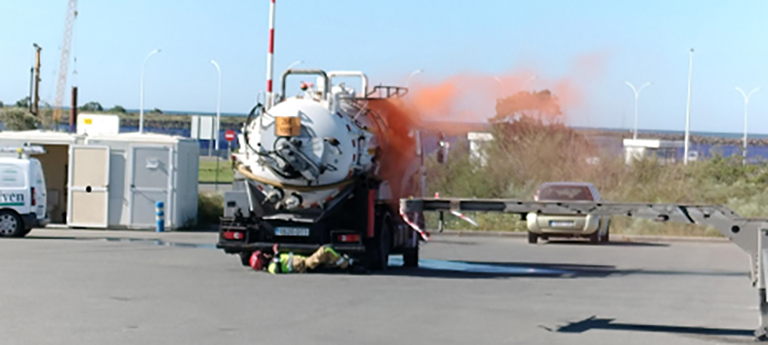
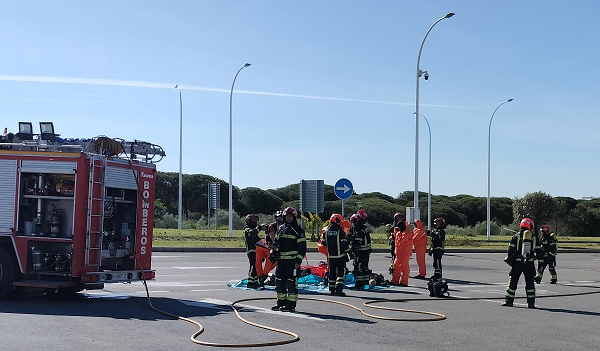
Through these exercises, we have sought to achieve the following objectives:
- To familiarise the Intervention Group with accidents involving vehicles transporting dangerous goods.
- To familiarise the Port Authority, the port police, with their operational procedures.
- To train staff in communication procedures between the parties involved in the Self-Protection Plan.
- Put what has been learnt in previous drills to the test.
Deploying the following teams:
- URQ (Chemical Risk Unit)
- 1 BUP (Heavy Urban Pump)
- 1 BNP (Heavy Tender Pump)
- Port Police vehicles
With regard to the Internal Maritime Plan, and independently of participation in the mandatory exercises at port terminals, the Directorate-General for the Merchant Navy (DGMM), part of the Ministry of Transport and Sustainable Mobility, through the Huelva Harbour Master’s Office (CMH), together with the Maritime Safety and Rescue Society (SASEMAR), Huelva Port Authority (APH), MOEVE and the Civil Protection Department of the Regional Government of Andalusia, conducted a marine pollution response drill, deploying real resources. The scenario was as follows: A vessel moored and loading fuel oil at Berth 4 of the Reina Sofía Jetty (RS4) is struck by a tugboat which, whilst en route to the Juan Gonzalo quay, suffered a loss of power and steering.
Due to the loss of steering, the tugboat is unable to avoid colliding with the moored vessel at the level of its cargo tank, causing a spill of cargo into the estuary. As the impact occurs perpendicular to the jetty, the mooring lines do not break. The loading arm does not disconnect despite the impact, as there is insufficient movement.
The pollution incidents under consideration take place in the port waters of Service Zone I of the Port of Huelva, with the pollution spreading from the Reina Sofía jetty towards the north-west and towards the left bank of the estuary, due to the effect of the tide. This could affect the Marismas del Odiel nature reserve to a lesser extent. The following plans were activated in this exercise.
Maritime subsystem
- PIM MOEVE (DECAL’s Internal Maritime Plan for its facilities located in Service Zone I of the Port) The vessel’s SOPEP plan is assumed to have been activated.
- PIM PUERTO DE HUELVA (Port of Huelva’s Internal Maritime Plan), Zone I
- PMN (National Maritime Plan for response to marine pollution), at level 1.
Coastal subsystem
- PECLA Regional Government of Andalusia (Territorial Emergency Plan for the Risk of Coastal Pollution in Andalusia), including the PN Marismas del Odiel Self-Protection Plan.
- RIBERA PLAN (State Plan for the Protection of the Seashore against Pollution).
The general objectives of the exercise were:
- To establish response structures and test established operational procedures, as well as to utilise the available material and human resources to respond to the simulated pollution scenario.
- To strengthen cooperation and assess the level of coordination between the various administrations, bodies, institutions and companies involved in a marine pollution incident and its response, in accordance with the provisions of the National Marine Pollution Response System.
- To familiarise and train response teams in the handling of LCC equipment and resources and in pollution control techniques.
- To facilitate the review of the PMN by proposing possible amendments based on the conclusions drawn from the exercise.
- To assess the Spanish Administration’s capacity for the management, coordination and response to a pollution incident in different emergency situations, including incidents involving hydrocarbons.
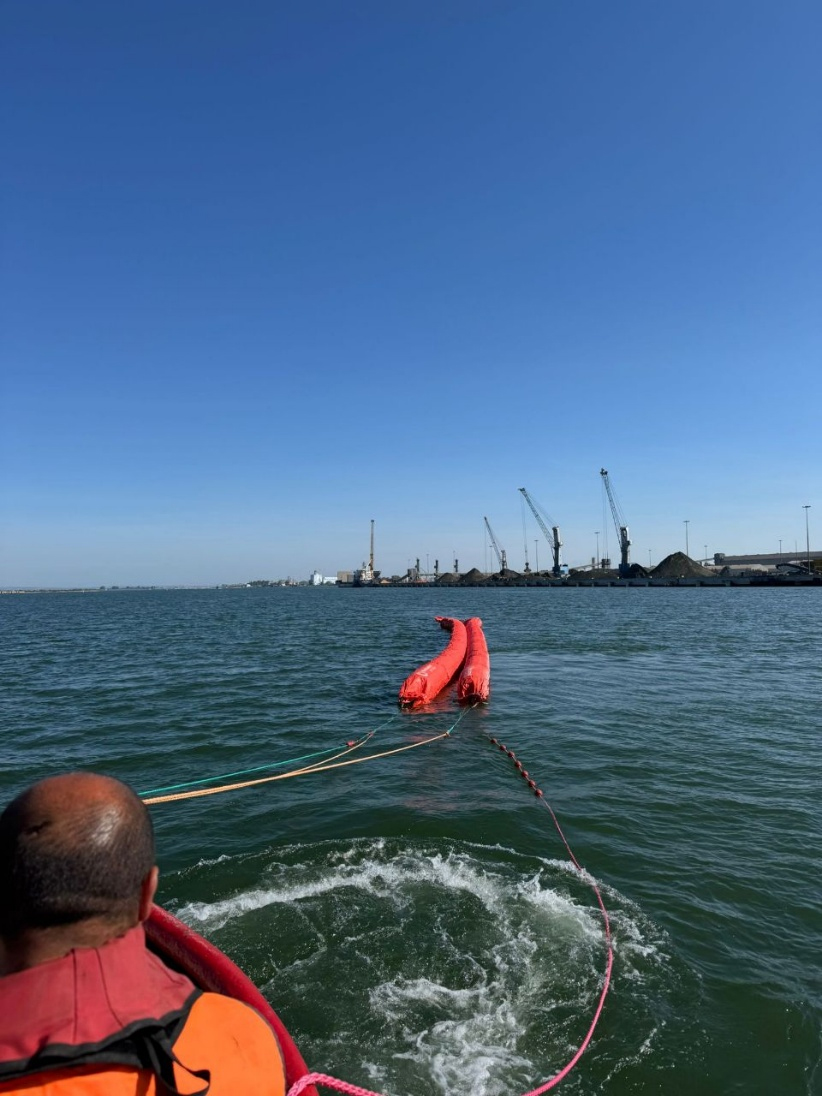
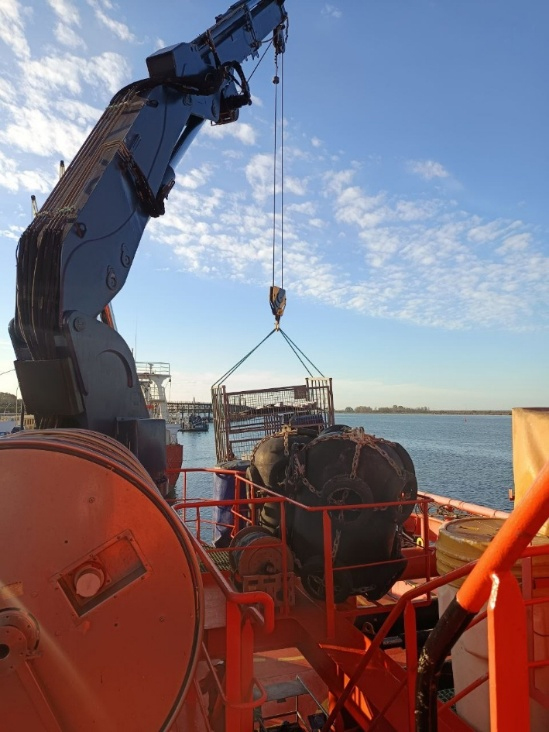
Achieving the following operational objectives:
- Determining the correct adherence to established operational procedures, as well as response and action times with the various resources, and their potential optimisation.
- Strengthening cooperation and coordination between support vessels and resource deployment vessels, as well as the CCS, the area coordinator, the directors of the activated PIMs and the various operational activities.
- Verification that safety standards are maintained throughout the exercise.
- Verification of the condition of the LCC equipment to be deployed during the exercise and the potential combination of equipment from different agencies or bodies, as well as their coordination.