
Evolution of traffic (I_10)
The trend over the last three years in both the total tonnage handled at the Port of Huelva and the tonnage handled by generic cargo groups, as well as the percentage of each of these groups out of the total, is as follows:
| 2023 | 2024 | 2025 | |
|---|---|---|---|
| Tonnes moved | 30,085,963 | 31,110,070 | 30,310,150 |
| Developments | -6.41% | 3.40% | -2.57% |
| Liquid bulk | 22,655,157 | 23,852,916 | 22,566,795 |
| Liquids as a percentage of the total | 75.30% | 76.67% | 74.45% |
| Solid bulk | 5,671,421 | 5,293,079 | 5,438,953 |
| Representation of solids in the total | 18.85% | 17.01% | 17.94% |
| General Merchandise | 1,459,115 | 1,742,738 | 1,842,087 |
| Overall representation of the total | 4.85% | 5.60% | 6.08% |
| Others (fishing, victualling and inland traffic) | 300,269 | 221,223 | 462,315 |
| Representation others/total | 0.99% | 0.71% | 1.53% |
The Port of Huelva closed the 2025 financial year with a total port traffic volume of 30.310 million tonnes, representing an increase of 2.57% compared to 2024 traffic figures.
Bulk cargoes remain the dominant sector as the Port of Huelva’s traditional area of specialisation, although the ongoing strategy of diversification into other business segments is permitting the Port to move closer to becoming a global port, with an increase in the share of general cargo in all its forms, including conventional cargo, containerised cargo and roll-on/roll-off cargo.
With regard to liquid bulk, volumes exceeded 22.5 million tonnes, with this category being the main cause of the decline in total volume during 2025. As noted in last year’s report, exceptionally high volumes of both crude oil and refined petroleum products were handled in 2024, whilst 2025 was a more moderate year, closer to the average for this type of cargo. At the MOEVE La Rábida energy plant, refining activity has returned to normal levels.
With regard to the second largest liquid by volume, liquefied natural gas, the trend in 2025 was positive, thereby offsetting part of the losses from other liquids mentioned above. The ENAGÁS logistics terminal in Huelva has recovered part of the volume lost in previous years following the outbreak of the war between Russia and Ukraine.
As a result, the ENAGÁS facility ended the 2025 financial year having handled 2.9 million tonnes of liquefied natural gas in total, thereby achieving a growth of over 14.4% compared to 2024.
For ENAGÁS, the Huelva terminal remains a strategic hub not only for unloading LNG but also for loading (shipments), as over 210,000 tonnes were shipped from its facilities last year, representing a growth of more than 9% compared with the previous year. These shipments are mainly intended to provide LNG bunkering services, as demand is experiencing significant growth driven by the need to decarbonise maritime transport and comply with stricter environmental regulations.
Vegetable fats and oils have once again established themselves as a strategic liquid bulk commodity in the Port of Huelva, reaching volumes in excess of 1.2 million tonnes. This represents a growth of over 7% compared to 2024, with the DECAL, BIO-OILS and LÍPIDOS SANTIGA facilities intensifying their activities that are directly linked to the human food, animal feed and biofuel production sectors year after year.
As for solid bulk traffic, a total of 5.4 million tonnes were handled, representing a moderate increase of 2.76% compared to the previous year. Mineral concentrates, associated with the traditional copper mining and manufacturing industry based in Huelva, grew in volume by nearly 100,000 tonnes, representing a 4.83% increase. Most of these concentrates consist of copper and zinc ore shipments handled by companies such as IMPALA and ATLANTIC COPPER.
However, the solid material showing the most significant growth in 2025 is cement and clinker, with an increase of almost 300,000 tonnes compared to 2024. With a growth of over 160%, bulk cement shipments from the VOTORANTIM facilities in Niebla (Huelva) and from CEMENTOS PORTLAND VALDERRIVAS in Alcalá de Guadaira (Seville) have continued the upward trend begun in previous years.
Coal and coke, which are directly linked to the supply and distribution of energy resources carried out by GARCÍA MUNTÉ in the Port of Huelva, also saw a growth of over 11% in 2025.
On the other hand, although grain and feed traffic in 2025 exceeded 1.5 million tonnes, it failed to reach the 1.7 million tonnes handled in 2024, resulting in a decline of over 11%. The main factors behind this decline are once again linked to the conflict in Ukraine, as until 2024 it was one of our country’s main suppliers. There has also been some recovery in domestic cereal production, which has reduced the need for imports.
The equally positive trend in general cargo during 2025 has led to an overall growth of around 5.7%. The majority of Huelva’s general cargo traffic is concentrated at the South Quay, and it is thanks to the strong performance in container handling that record figures were achieved during 2025. Specifically, empty containers, with a 53.3% increase; rolled steel products, with a rise of 25.2%; and vehicles transported as general cargo, which grew by almost 140%, were the most significant goods handled during 2025.
Container traffic continues the upward trend of recent years, closing 2025 with a total throughput of 152,460 TEUs, representing a growth of over 42%. This increase was particularly significant thanks to the launch of a new container transit route by the Hapag-Lloyd fleet which, with the aim of alleviating occasional congestion at nearby ports such as Algeciras, began in April and continued throughout the rest of the year.
Container traffic continues its upward trend of recent years and closes 2025 with a total movement of 152,460 TEUs.
As for Ro-Ro and Ro-Pax traffic, 2025 ended with higher activity than the previous year. The frequency of the regular routes operated by BALEARIA connecting the port of Huelva to the Canary Islands increased, and the financial year closed with a 7.86% increase in the number of Intermodal Transport Units (ITUs). The Port of Huelva continues to occupy a prominent position within the Spanish Port System in terms of its connectivity with the Canary Islands, as it continues to offer four connections per week.
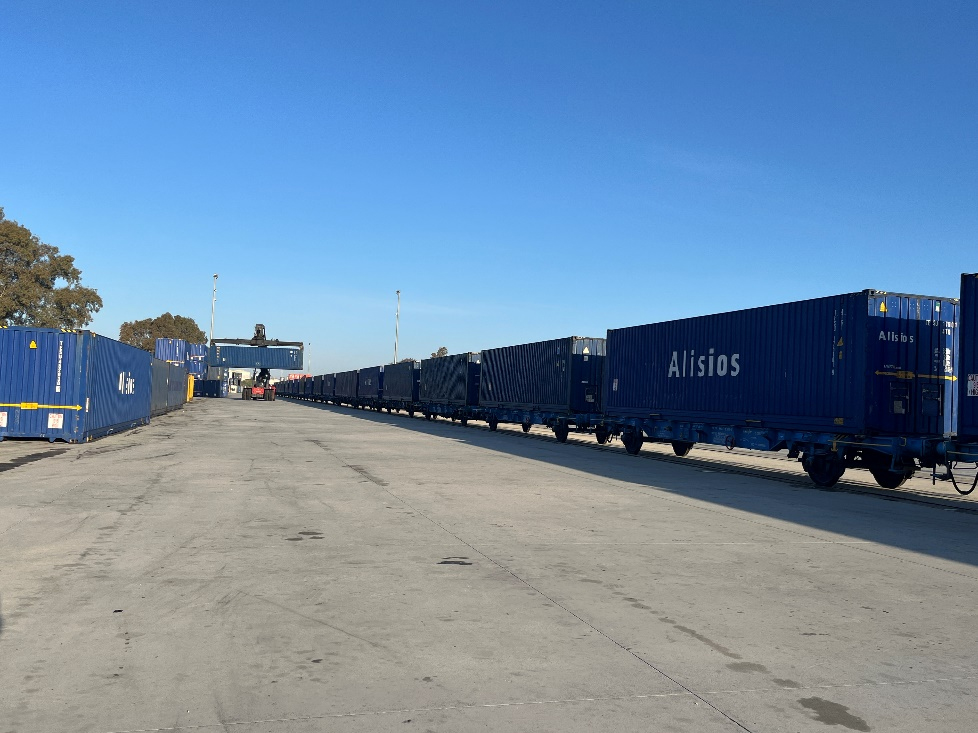
These figures indicate that the Port of Huelva’s commitment to diversifying its activity as an intermodal and logistics port is paying off with respect to the growth of conventional and containerised general cargo, all of which is concentrated at the South Quay’s intermodal platform. In support of this diversification objective, throughout 2025 the port has continued to provide quality services for containerised cargo and to consolidate the Huelva-Casablanca-Spanish Mediterranean connection operated by the logistics provider ALISSIOS SHIPPING.
According to this data, the Port of Huelva’s commitment to diversifying its activity as an intermodal and logistics port is paying off in the growth of conventional and containerized general cargo.
On the other hand, 2025 ended, as was the case the previous year, with a decline in passenger numbers on the regular service to the Canary Islands. There was a drop of more than 8%. With the departure of Naviera Armas in 2024 and the reduction in the number of connections on Route 1400 Huelva-Canary Islands, there have also been declines in vehicle movements under the passenger regime (-5%), but not in general Ro-Ro wheeled goods traffic, which grew by 7.86% as mentioned above.
Finally, in 2025, rail freight traffic at the Port of Huelva exceeded road traffic by 8.3%, contributing to the strengthening of environmental protection policies and the reduction of greenhouse gas emissions. A total of 1,998 rail operations took place, of which 38% were container rail operations. The corridors established in previous years with Seville and Madrid were maintained, closing the year with 22,579 TEUs.
The Spanish port system, comprising 28 Port Authorities, closed 2025 with a very slight decrease of 0.2% compared to the total tonnage handled the previous year. These figures have contributed to the Port of Huelva’s progress within the overall system, positioning it as the seventh largest port nationally in terms of volume of goods handled. With regard to liquid bulk traffic, the system as a whole grew by 0.9% compared to 2024, enabling the Port of Huelva to retain third place in the national ranking for liquid volume, surpassed only by the ports of Algeciras and Cartagena.
Hinterland and foreland. Main origins and destinations of goods (I_11)
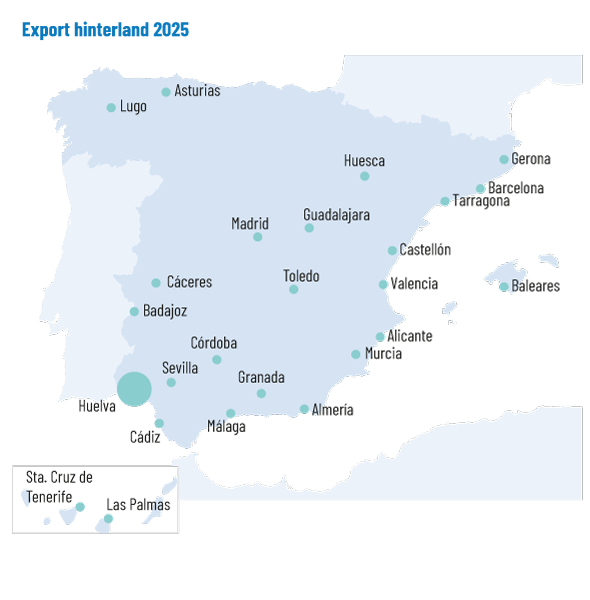
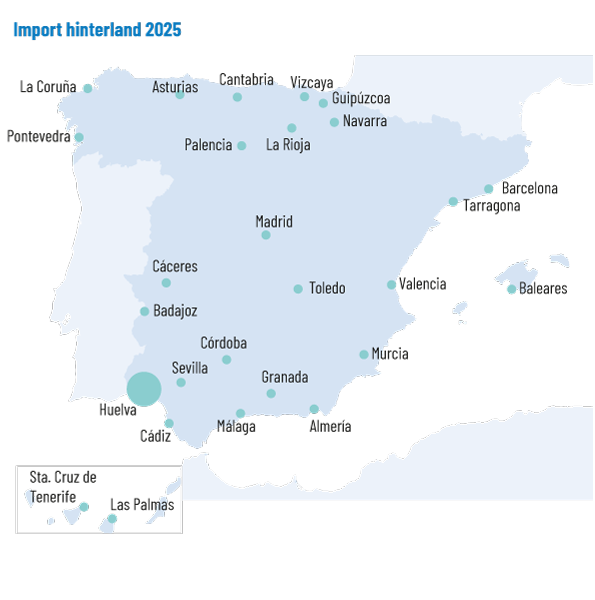
The extent of the catchment area—that is, the set of regions from which imports are sourced and exports distributed by the Port of Huelva—is particularly noteworthy, owing to the diverse countries of origin of the goods required by industry.
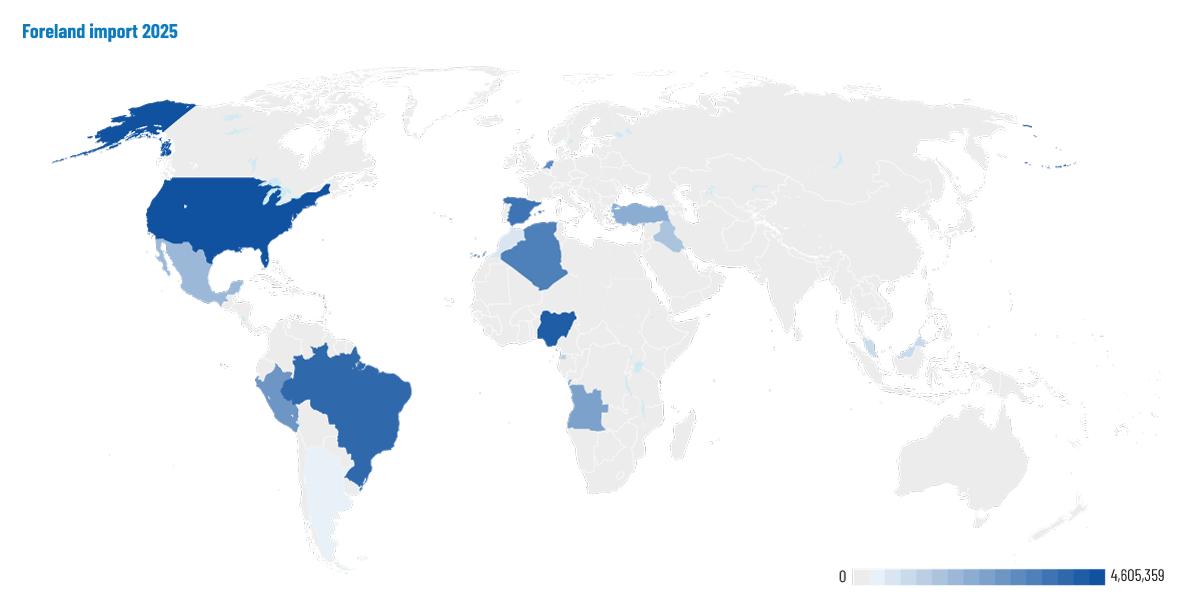
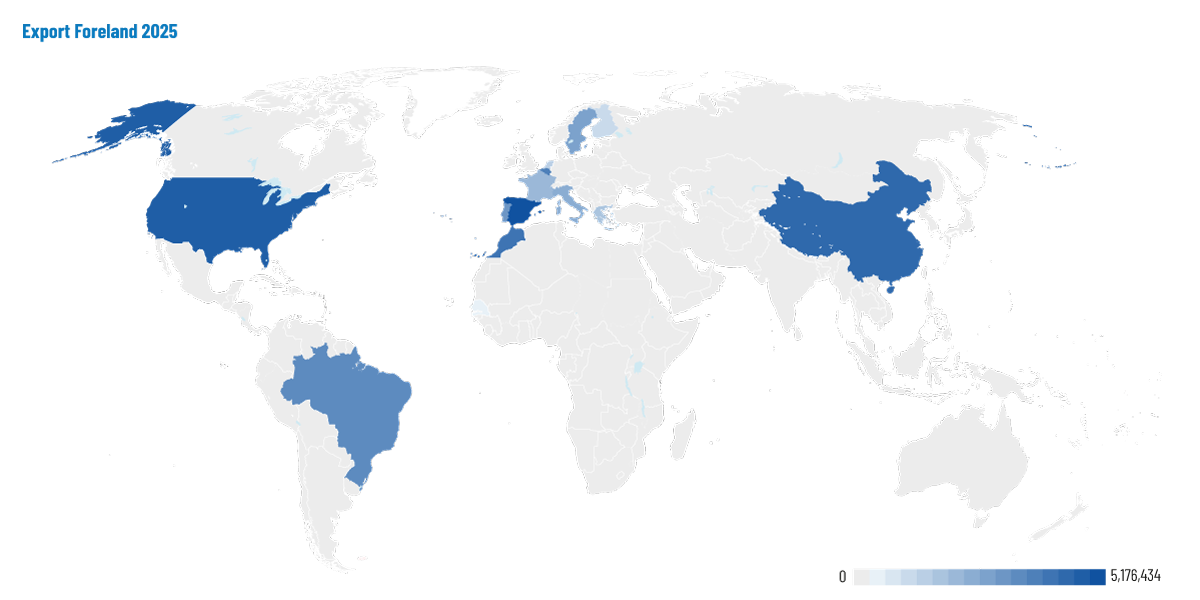
The import and export foreland is set out below, showing the main origins and destinations of the goods.
| Import Foreland 2025 | |
|---|---|
| USA | 4,605,359 |
| NIGERIA | 3,853,902 |
| BRAZIL | 1,296,333 |
| SPAIN | 1,282,303 |
| ALGERIA | 889,367 |
| NETHERLANDS | 640,129 |
| PERU | 506,029 |
| ANGOLA | 428,881 |
| TURKEY | 403,543 |
| MEXICO | 388,360 |
| IRAQ | 349,575 |
| EQUATORIAL GUINEA | 278,594 |
| MALAYSIA | 272,187 |
| MOROCCO | 271,944 |
| ARGENTINA | 266,069 |
| Export Foreland 2025 | |
|---|---|
| SPAIN | 5,176,434 |
| USA | 821,703 |
| CHINA | 703,393 |
| MOROCCO | 548,928 |
| BELGIUM | 413,806 |
| BRAZIL | 357,017 |
| PORTUGAL | 330,085 |
| SWEDEN | 326,332 |
| ITALY | 322,511 |
| FRANCE | 276,948 |
| GREECE | 237,635 |
| NETHERLANDS | 174,080 |
| FINLAND | 154,123 |
| GIBRALTAR | 136,915 |
| SENEGAL | 134,905 |
Turnover invoiced to top five customers (I_12)
Of a total turnover in 2025 of €49,510,476.35, the amount invoiced to the five main customers comes to €22,570,375.79, representing 45.59% of total turnover.
| Invoiced amount | % invoiced/total | |
|---|---|---|
| Total turnover | 49,510,476.35 | |
| Top five customers | 22,570,375.79 | 45.59% |
The five main customers are:
| Companies | Invoiced amount | % of total |
|---|---|---|
| Moeve, S.A. | 8,656,104 | 17.48% |
| Enagás Transporte S.A.U. | 4,016,117 | 8.11% |
| Ership S.A.U. | 3,715,386 | 7.50% |
| Decal España S.A. | 3,110,695 | 6.28% |
| Erhardt Shipping Services, S.L. | 3,072,074 | 6.20% |
Main sectors in economic development that rely on the port for their development (I_13)
The main sectors in which companies within the Port Community operate are:
Industrial sector
a) Energy: Moeve’s refinery and biofuel plants, the Enagás regasification plant, the Magnon biomass plant, etc.
b) Metallurgy: copper cathodes from the Atlantic Copper smelter are shipped from the Ingeniero Juan Gonzalo Quay.
c) Chemical: with plants such as those of Moeve Química, Fertiberia, Venator, Grupo Tervalis, Electro Química Onubense, etc.
d) Mining: minerals arrive at the Ingeniero Juan Gonzalo Quay, mainly copper concentrate for Atlantic Copper.
Logistics sector
a) Fuel terminals: Decal España, Exolum, Repsol.
b) Ore terminal: Impala Terminals.
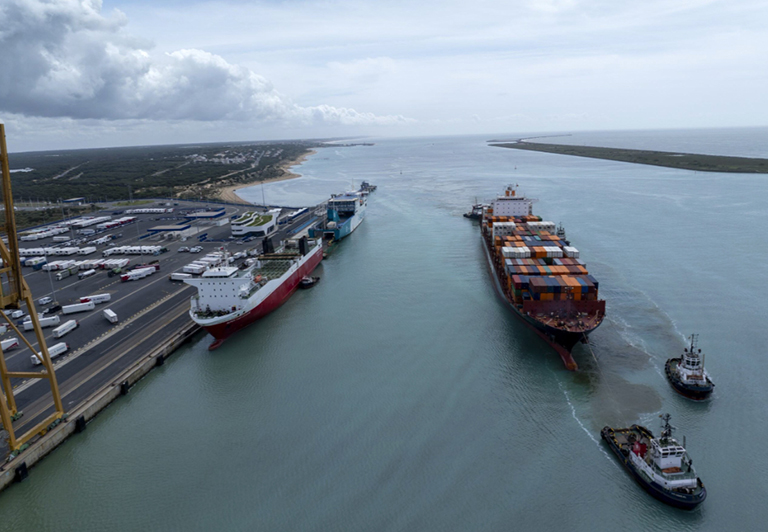
c) Container terminal: Yilport
d) Majarabique rail terminal: Termisur.
e) Regular shipping routes to Northern Europe, the Canary Islands and Morocco, the Spanish Levante, the Mediterranean and the Middle East: CMA-CGM, Alisios Shipping, Balearia & FredOlsen, Suardiaz & GTO, MCI and Messina.
Fishing sector
With a fish auction market for first sales and a wholesale market.
Cruise tourism sector
Cruise tourism has picked up again; in 2025, 15 small cruise ships called at the Muelle de Levante.
In addition to those directly related to commercial and port activities and services, such as: loading and unloading, customs agencies, shipping agents, freight forwarders, bunkering, victualling, provisioning, ship repairs, storage, etc.
In 2025, 15 small cruise ships made stops at the Levante Dock.