
Current and planned road and rail accesses and promotion of port-rail intermodality (I_22)
The main road access routes to the Port of Huelva are via the A-49 motorway (Seville-Huelva-Portugal), via the N-441 (from the north), H-31 (from the east) and H-30 (Huelva Eastern Ring Road), which extends southwards to the N-442, from which the Outer Port is accessed. Also important for the Port of Huelva are the N-435 (from Badajoz and Zafra to Huelva) connecting with Extremadura, which links up with the A-49 at San Juan del Puerto, the N-431 (Huelva-Portugal) and the regional roads A-494 (from San Juan del Puerto to Matalascañas via Mazagón), A-5000 (from Huelva to San Juan del Puerto), A-5025 (from the A-494 to the N-442 via La Rábida) and the A-497 and A-492, which, via the bridges over the River Odiel, link the port area with Punta Umbría and other towns on the western coast of Huelva.
The most significant planned works for the Port of Huelva, in terms of external road network connections, are those designed to ensure a high standard of service on the A-49 motorway, as well as on the N-435 towards Extremadura. Specifically, the continuation of works to increase the capacity of the A-49 on the sections with the heaviest traffic and the conversion of the N-435 (future A-83) into a dual carriageway, as is the case with the Trigueros and Beas bypasses.
As for the internal road network of the Service Area, this is well-equipped to provide an excellent level of service. The main artery is the route comprising Avenida de Hispanoamérica, Avenida Francisco Montenegro (Punta del Sebo road) and the Puente del Tinto bridge, linking the inner docks and the Outer Port. Via the connection to the main network, the Port of Huelva links up with the General Interest Railway Network managed by ADIF, with the Huelva Mercancías rail logistics terminal nearby, from which goods are dispatched, received and sorted, with the option of self-handling for shunting and train operations.
With regard to internal road network connections, works have been carried out, such as the new junction between the N-442 and the single access road to the Outer Port (last-mile project); and others of particular interest are planned, such as the new bridge over the River Tinto, connecting the A-494 on the Palos de la Frontera bypass with the H-30 (Huelva Eastern Ring Road).
The N-442 national road links the towns of Huelva and Mazagón and carries heavy traffic, with a high volume of heavy goods vehicles coming from the existing industrial estate where the La Rábida MOEVE Energy Park (formerly CEPSA) and the Enagás regasification plant are located, as well as the Outer Quay of the Port of Huelva, where the South Quay is situated. This quay is used for general cargo, containerised traffic and Ro-Ro, and it is here that significant investment has been made to support opportunities for further expansion and future development of the Port of Huelva. During the summer season, this traffic becomes particularly heavy, as it is the main route between Huelva and the beaches of Mazagón and the surrounding area.
For these reasons, it is necessary to widen the entire road, a project that has been in the planning stage for over a decade, as well as reorganise all access points to the N-442 via service roads, removing some junctions or replacing them with grade-separated junctions, and increasing capacity. This is not forgetting the construction of the second bridge over the Río Tinto to relieve traffic congestion and ensure escape routes in the event of potential emergencies.
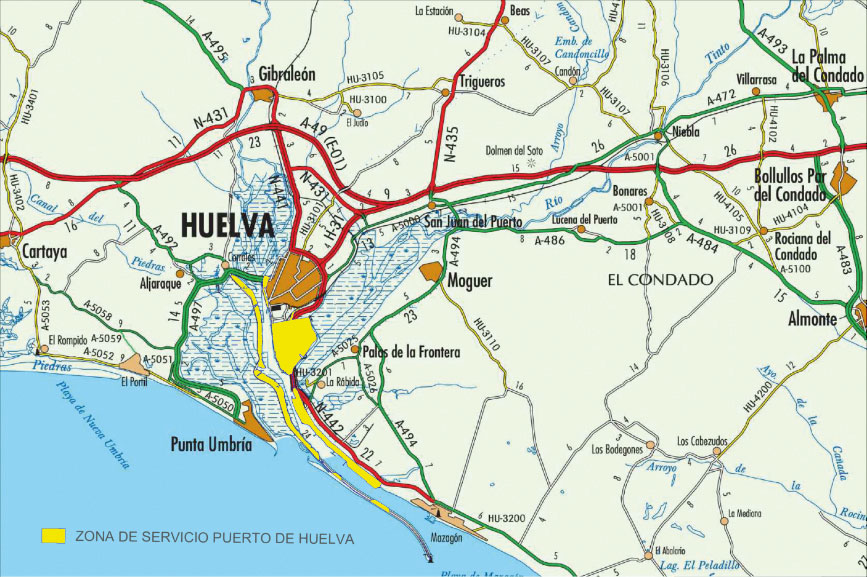
For the Port of Huelva, public investment aimed at improving rail and road connectivity with the centre of the peninsula, via Seville, is of strategic importance, as the V Centenario Motorway (A-49) is currently congested.
With regard to rail connections, Huelva Port Authority has had an agreement in place with ADIF since 2011. This agreement regulates the port’s functions as a rail infrastructure manager and establishes how it connects to the General Interest Rail Network. This is in accordance with Law 38/2015 of 29 September on the railway sector, which repeals Law 39/2003.
With regard to the Improvement of Rail Accessibility, both for projects located within the Port Service Area and at relevant locations outside that Service Area, the commissioning of the CMS (Control, Command and Signalling) subsystem in 2024 is of note. This is interconnected with the CTC (Centralised Traffic Control Centre) at Santa Justa, enabling safe interactions through automatic block signalling on the double-track section via the connecting line, thereby increasing the capacity of the Port’s railway infrastructure.
Several sections of track 2S2 have been renovated by refurbishing the existing sub-beds: sub-ballast and ballast, as well as replacing the existing wooden sleepers and RN-45 type rails.
Huelva Port Authority and ADIF have signed an agreement regulating the APH’s financial contributions from the Port Land Accessibility Fund in relation to its contribution to improvement works on the Huelva-Seville line. Specifically, €11 million has been allocated to the construction of two 750-metre sidings on the Seville-Huelva line. This will allow the movement of 750-metre freight trains, thereby optimising the rail corridor.
The Port of Huelva boasts excellent land connectivity, particularly by rail, with its hinterland. However, it is advisable to continue promoting projects to improve the capacity of these infrastructures to meet the new standards of rail transport. ADIF plans to adapt the gauges for the Huelva-Seville rail motorway (https://www.adif.es/servicios/mercancias/autopistas-ferroviarias).
On an internal level, the I-RAIL project (Interoperability of the rail system with TAF TSI in TEN-T Corridors) involves the main players in the rail freight sector in Spain, Portugal and Italy, with the support of the European Union Agency for Railways and the Spanish Railway Safety Agency. It aims to improve interoperability in the exchange of information within European rail freight services through digitalisation and the use of the TAF and TSI technical standards (defined in the Interoperability Directive 797/EC/2016), as well as to make rail freight transport more competitive in terms of both cost and time. In 2025, work was carried out to facilitate the exchange of messages between the various stakeholders (railway undertakings, infrastructure managers, etc.).
In 2022, Huelva Port Authority received approval from the Sustainable and Digital Transport Support Programme for the project known as ROUTE TO A PORT INTERCONNECTED AND DIGITAL (RAPID). The objective of the project is the design, development, validation and implementation of a digital platform for the Port Community of the Port of Huelva, comprising a system of federated platforms based on the NGSI-v2 European data exchange standards and its implementation via the FIWARE ecosystem. This aims to provide solutions for the digitalisation of processes and infrastructure and addressing the needs of the port environment and the logistics and service chain associated with and inherent to the port through contextualised information-sharing technology amongst the various network stakeholders. The project was awarded a budget of €1,267,925 with 40% funding. The project was completed during the 2025 financial year, with the implementation of the various actions being a key highlight.
- Second pilot of the container number plate reading system.
- Completion and launch of the port services digitisation platform.
- Deployment of sensor and data collection infrastructure, and single access control surveillance systems.
In 2025, the ROUTE TO A PORT INTERCONNECTED AND DIGITAL II project (hereinafter RaπD II) was approved. This is an extension of the RaπD project, approved by the Sustainable and Digital Transport Support Programme, which forms part of the Recovery, Transformation and Resilience Plan – funded by the European Union – NextGenerationEU.
The aim of the project, therefore, is to continue advancing the design, development, validation and implementation of a digital platform at the Port of Huelva, comprising a system of federated platforms, thereby complementing the work being carried out in the other project. Specifically, the RAPID II project envisages several measures, including:
- Upgrading hardware infrastructure to achieve greater computing power and storage capacity, thereby enhancing the resilience of the Port of Huelva’s Digital Platform and enabling better integration of the large-scale deployment of IoT sensors and the port services management platform.
- Improving the access control infrastructure at Huelva Port Authority’s public quays, both in the Inner Port and the Outer Port, where the Port of Huelva’s main general cargo traffic takes place. This will enable the port to continue making progress in the creation of dynamic security zones.
Meanwhile, in 2025, the CEF Intermodal Platform II project at the Port of Huelva was completed, aiming to transform the Port of Huelva into a sustainable and resilient port through the construction of a new Ro-Ro ramp at the South Quay and the implementation of an electricity supply at the Mineral Quay for tugboats. The completion of these projects has eliminated existing bottlenecks in the port infrastructure and improved the management of expected road traffic demand. The new infrastructure will further boost the development of the Atlantic Corridor, which includes the Port of Huelva as the official hub for the maritime connection with the Canary Islands. The works included in the project are:
- Construction of a new Ro-Ro ramp at the South Quay.
- And the installation of an electricity supply at the Mineral Quay.
Furthermore, in mid-2025, two further CEF projects were launched with the aim of improving the competitiveness of the Port of Huelva, requiring the optimisation of the efficiency and effectiveness of management through state-of-the-art support systems.
The NELSON project, which stands for Development of Navigational Efficiency and Safety with Digital Solutions for Future Fairways, aims to implement smart applications that enable the provision of new digital services between ships and shore, based on the creation of smart fairways. These are official maritime routes marked on a nautical chart that utilise data, new technologies and automated solutions to improve the safety, efficiency and reliability of maritime traffic, whilst reducing climate impact and other environmental effects. The aim of the project is to establish a harmonised and standardised information exchange environment between ships and shore; it comprises complementary work and studies in Finland, Sweden and Spain.
The eFTI4LIVE project aims to carry out new parallel studies and use cases, utilising the lessons learnt, the open-source eFTI reference implementation code and the reference architecture already developed in previous projects (eFTI4EU and eFTI4ALL). The eFTI4LIVE project serves to foster collaboration between Member States, addressing upcoming eFTI requirements, working together on common specifications and contributing to the creation of a harmonised eFTI exchange environment across Europe in line with the regulation.
The project includes rail and road connections to the port of Huelva, preparing and evaluating the entire eFTI interchange environment with additional platforms, including the Port Community Systems (PCS) operating at the port. Furthermore, at the port of Huelva, the use case is under consideration for a Maritime eFTI corridor, where goods travel from the centre of the peninsula, are subsequently transported by ship, and undergo last-mile distribution by lorry.
Boost to traffic by roll-on/roll-off loading and unloading (I_23)
The first milestone for rolling stock was in 2011 with the commissioning of a Naviera Armas Ro-Pax ferry operating a regular weekly service between Huelva and the Canary Islands. This was made possible by the installation of a floating Ro-Ro ramp by the shipping company.
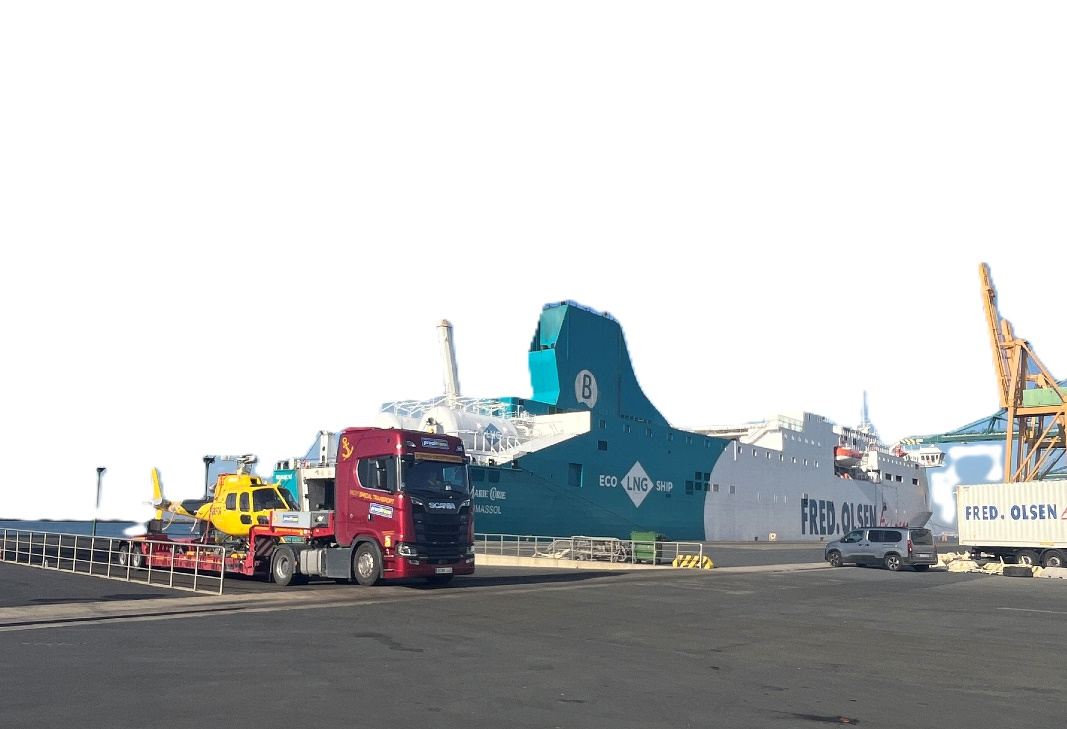
In 2016, alongside the opening of the new inspection facilities at the South Quay to streamline veterinary and phytosanitary inspections of animal and plant products entering the European Union via this infrastructure, this type of traffic received a further boost.
In 2018, Huelva Port Authority acquired the Ro-Ro ramp, enabling the launch of a new service to the Canary Islands operated by Balearia & Fred.Olsen. By 2025, the number of weekly sailings to the Canary Islands ranged between three and four per week.
It is worth noting that, on completion of work on the second Ro-Ro ramp at the South Quay, the ramp was brought into service in October 2025.
This new ramp, located further south, complements the existing one, enabling the simultaneous operation of three ferry-type vessels, which carry road freight on lorries and trailers. This aims to improve multimodality and the decarbonisation of freight transport, enhancing the Port of Huelva’s current connections, as well as facilitating and accelerating the establishment of new shipping lines operating to other destinations in Europe and third countries. This enhances competitiveness as a leading intermodal hub in south-western Europe.
Furthermore, a new gangway has been installed for the embarkation and disembarkation of passengers, and a pedestrian walkway has been established along the entire southern section of the South Quay.
Developments in rail and road transport and road operations (I_24)
The following table shows the trends over the last three years at the Port of Huelva of the percentage of goods entering and leaving the Port by rail, in relation to traffic handled by road and rail. It also shows the trends of the percentage of maritime goods entering and leaving the Port via road-based loading and unloading operations, in relation to the total volume of general maritime import-export goods. Given its importance to the Port of Huelva, the trend in pipeline transport is also shown.
| 2023 | 2024 | 2025 | |
|---|---|---|---|
| Tonnes moved | 30,085,963 | 31,110,070 | 30,310,150 |
| Railway | 348,705 | 621,388 * | 542,606 * |
| Road | 6,646,559 | 6,706,731 | 6,533,137 |
| Rail + road | 6,995,264 | 7,328,119 | 7,075,743 |
| % Rail/rail + road | 4.98% | 8.48% | 7.67% |
| Pipe | 20,402,399 | 20,997,199 | 20,261,803 |
| General Merchandise | 1,459,115 | 1,742,738 | 1,842,087 |
| Roll-on/roll-off cargo (non-TARAS) | 651,446 | 539,294 | 555,863 |
| % Rolling/General M. | 44.65% | 30.94% | 30.18% |
*Traffic declared by railway undertakings.
| 2025 | |
| Freight | Tm |
| Oils | 214,682.45 |
| Ammonia | 63,245.84 |
| Coils | 6,739.2 |
| Coke | 0.00 |
| General | 211,132.21 |
| Profiles | 0.00 |
| Propane | 44,129.03 |
| Adblue | 2,677.5 |
| Grand total | 542,606.23 |
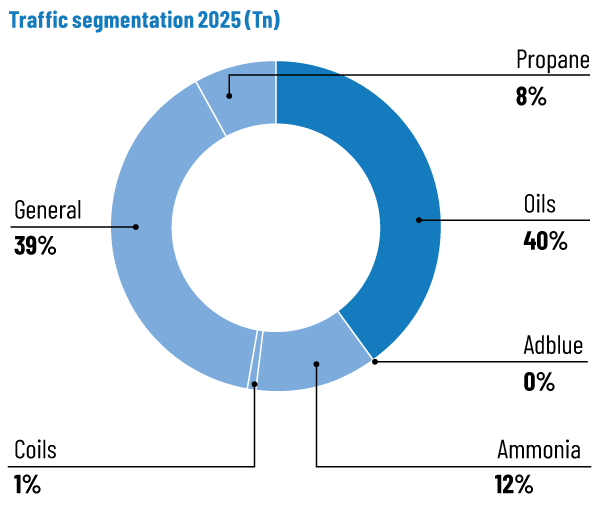
In 2025, general cargo transported by rail increased:
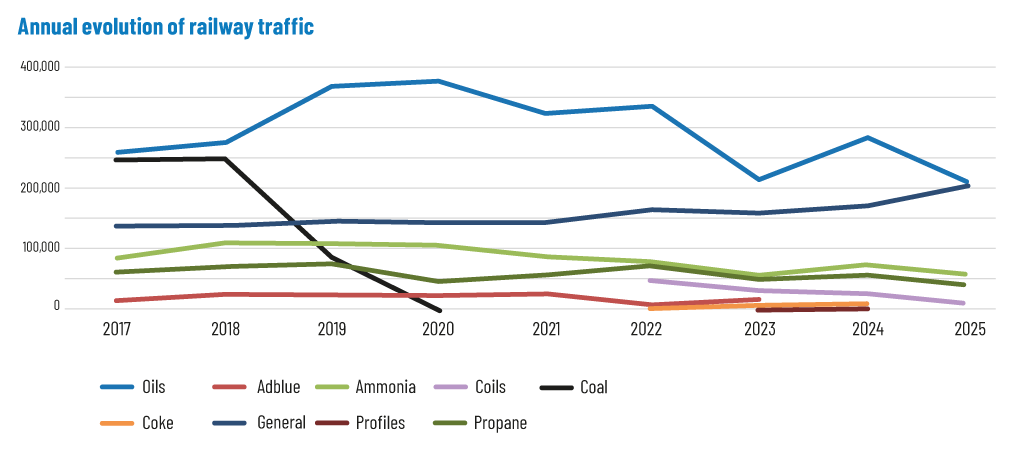
| Sum of TN | 2017 | 2018 | 2019 | 2020 | 2021 | 2022 | 2023 | 2024 | 2025 |
|---|---|---|---|---|---|---|---|---|---|
| Oils | 260,940.97 | 277,520.01 | 371,579.98 | 380,303.16 | 326,355.06 | 338,350.96 | 215,875.89 | 284,734.17 | 214,682.45 |
| Adblue | 15,787.52 | 24,360.65 | 24,543.21 | 22,353.73 | 24,406.80 | 6,821.40 | 12,462.50 | - | 2,677.50 |
| Ammonia | 88,236.38 | 110,307.30 | 109,221.42 | 106,001.58 | 87,419.97 | 78,940.37 | 56,212.25 | 73,212.25 | 63,245.84 |
| Coils | 5,369.51 | - | - | - | - | 47,159.75 | 30,621.23 | 25,512.96 | 6,739.20 |
| Coal | 248,650.00 | 250,750.00 | 86,150.00 | - | - | - | - | - | - |
| Coke | - | - | - | - | - | 675.10 | 5,529.64 | 9,556.50 | - |
| General | 140,175.66 | 139,605.96 | 145,009.00 | 143,778.78 | 144,209.85 | 165,702.78 | 159,986.53 | 171,913.34 | 211,132.21 |
| Profiles | - | - | - | - | - | - | 1,075.63 | 1,942.72 | - |
| Propane | 59,908.05 | 68,608.94 | 75,343.25 | 45,902.97 | 56,164.01 | 72,455.85 | 49,341.49 | 54,515.83 | 44,129.03 |
| Overall total | 819,068.09 | 871,152.86 | 811,847.76 | 698,340.22 | 638,555.69 | 710,106.21 | 531,105.36 | 621,387.77 | 542,606.23 |